Verbund
One sales rep, one car, a huge territory. The company’s whole memory fit in one notebook: Verbund turns it into a tool you build in a few clicks, one that holds up when the day goes off the rails.
The whole company
fit
in one notebook.
SDAG Adhésif
Two routes by car,
eleven visits observed.
Thirty-two things
to know, six boxes
Who’s chatty, who sees reps before ten, which machine runs in which workshop. The spreadsheet has six columns. The rest lives in a notebook that nobody else* can read.
nobody will know how
to redo my routes.”
What’s playing
over there
The dial stays put and turns. Whatever passes under the marker starts to play.
·
Say it,
it lays it out
One need, one sentence. Kuubo breaks it into steps, lays them on the canvas and links them up. You adjust, then you say “go”.
You talk,
it’s typed
Hold both keys, talk, let go. The text lands where your cursor was.
Your apartment
is the playlist
Each cube holds a track. Put them wherever you like, move them around, they’re yours. Then you point: whatever is in line plays, the rest stays quiet.
The ball
follows you
The cursor is you. The orange dot is your appointment. The object never tells you which way to go: the ball points at the goal, and its distance from the center tells you how far is left. You have time to spare. Spend it.
Weave
a fabric of thought
The AI never gives the answer. It asks the next question. Each answer becomes a mass on the canvas, and the fabric takes shape.
Turn,
and aim
Slid upright into the wall mount, the phone becomes a steering wheel. You turn it, the waves sweep the room, and you only hear what you have in common with whatever is over there.
The pocket
lab
The viewfinder is you. Frame whatever intrigues you: the camera asks you a question, you answer, and your answer prints as a sticker.
Twelve
seconds
The cursor is you. Step onto the road and you leave your footprints on it. The light is red, a few seconds to go. You can cross right now. You can also wait, and see what it costs.
Two phones down,
or silence
One phone on the base isn’t enough. Without a second one, Halo doesn’t wake up, and silence is a valid answer.
The client cancels.
Half the day’s gone
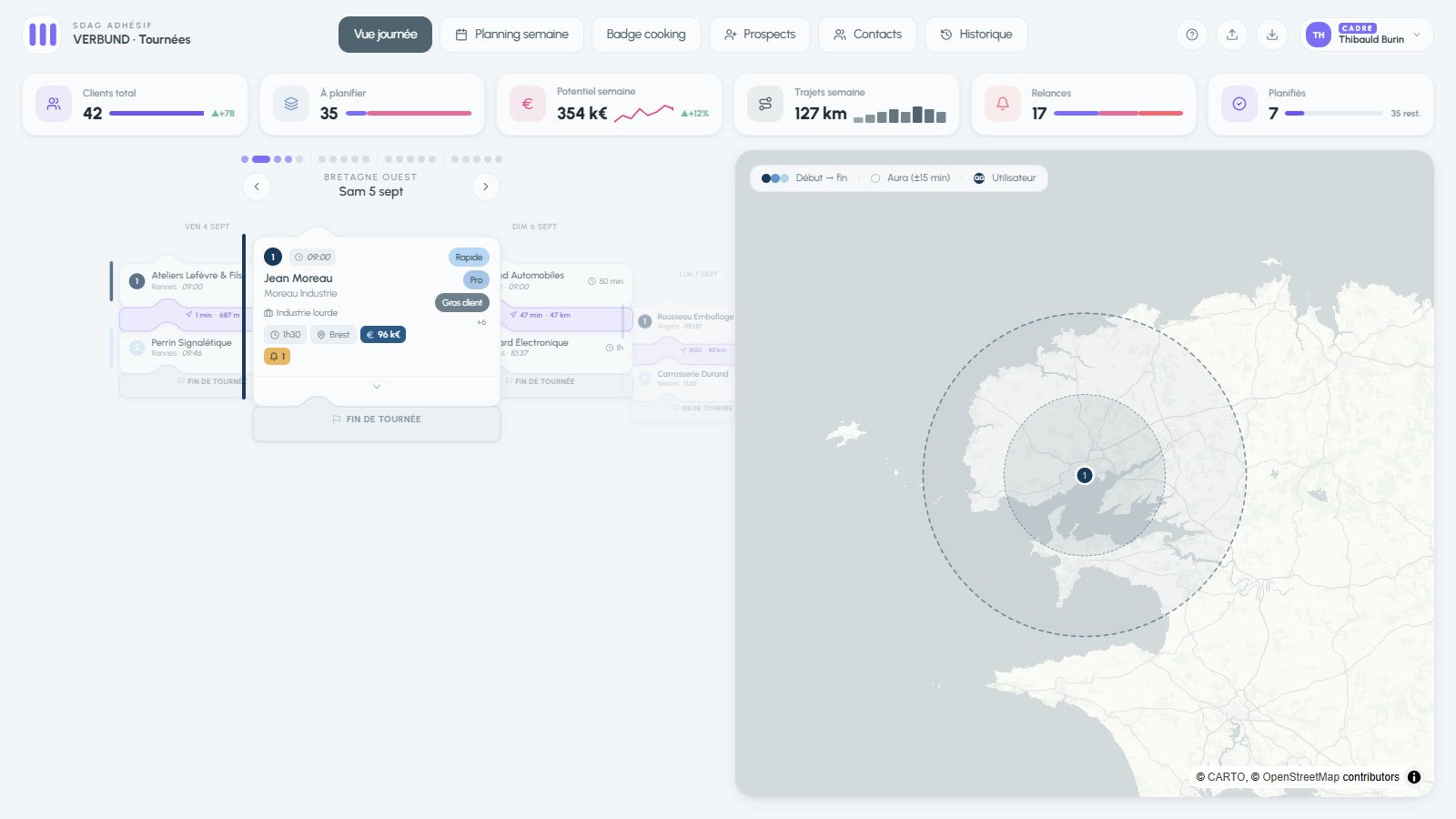
He’s on the road, a hundred kilometers from headquarters. Thought of as a list, the route breaks. Thought of as a territory, it pulls itself back together.
Powered by his rule*
The radius opens.
The map suggests.
kept as is
every morning


Badge cooking
His own word, kept as is.
On Fridays, he “cooks up” the next week.

Verbund doesn’t rearrange anything on its own.
It shows who’s within reach.
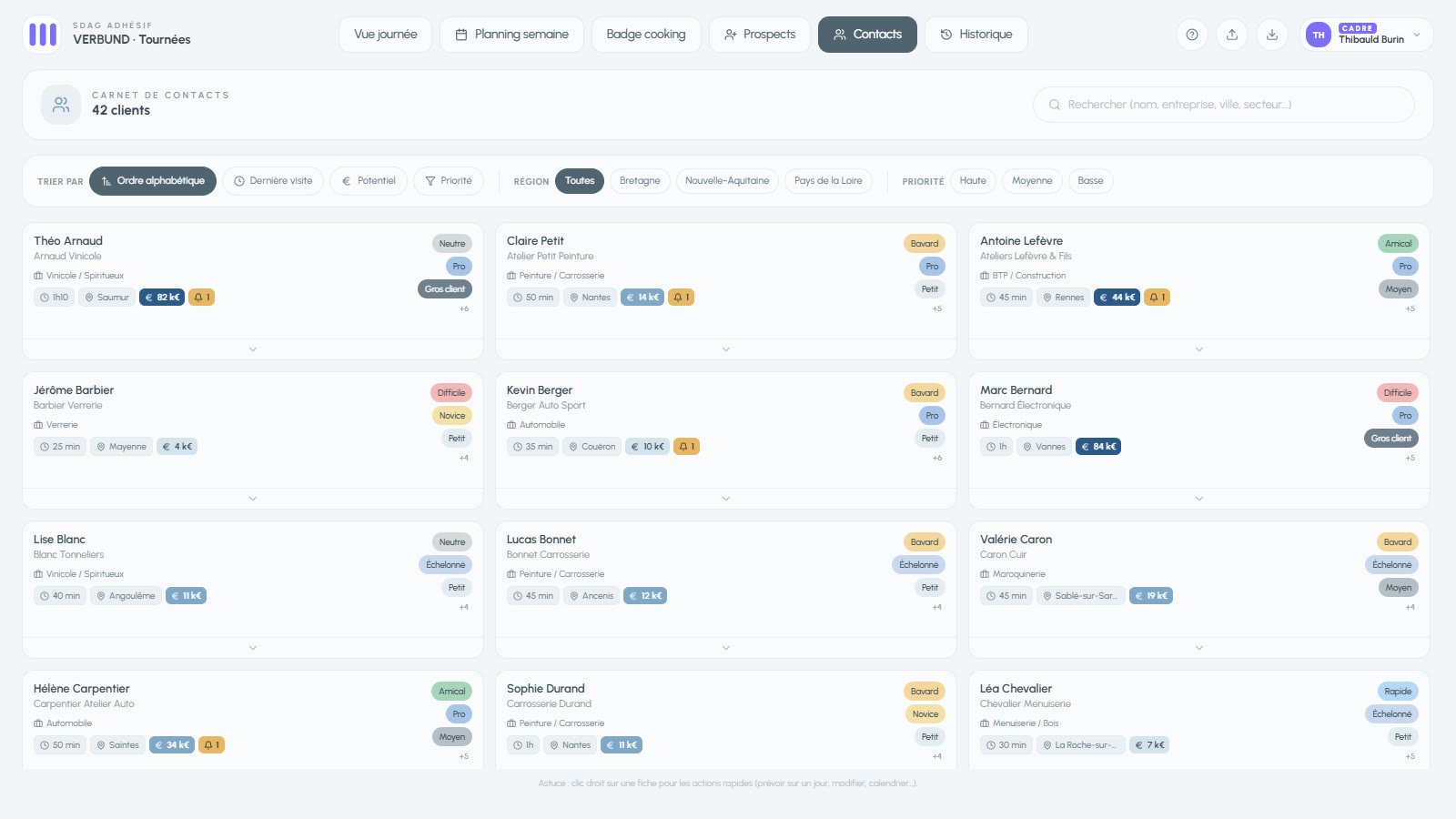
He jots three words in his notebook, in his own language: chatty, early bird, forty-ton press. Eleven tag families pick up that language: personality, expertise, size, priority, status, product, visit length, logistics, potential, follow-ups. The card reads at a glance in its brick, and unfolds if you want the detail.
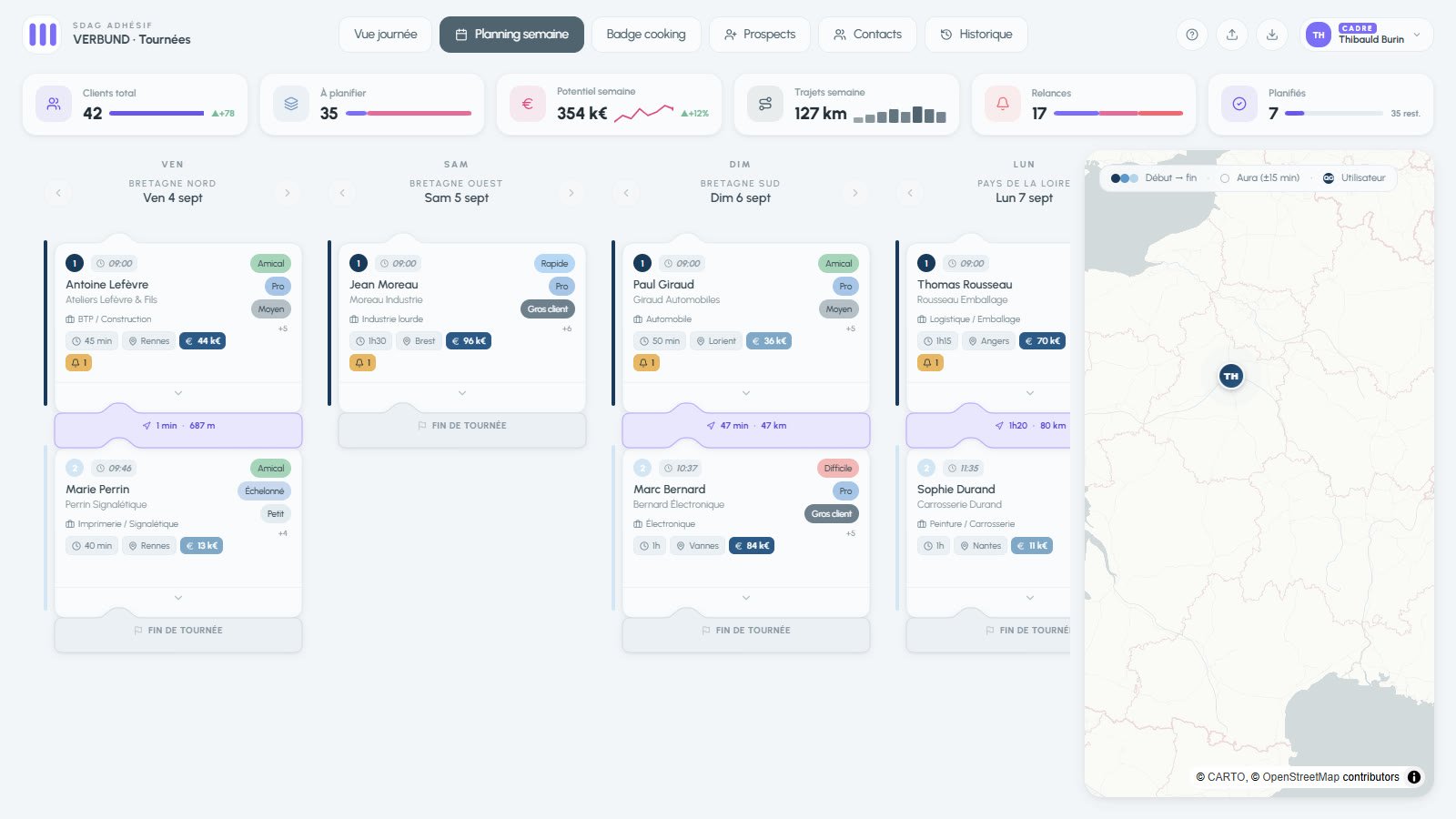
Every Friday, he puts together the next week. Each client is a hexagon in a tessellation, and you choose what the axes show: distance, potential, priority, last visit. Click after click, the day fills up on the left, the drives get calculated, and the cloud rearranges itself around the last client picked, with the closest one moving back to the origin.
A client cancels while he’s a hundred kilometers from headquarters. The freed-up time becomes a radius on the map, with his rule: one kilometer equals one minute. Verbund shows who’s within reach right now, and leaves the choice to him. The lost half-day closes around a client who wasn’t part of the morning’s route.
A CRM could do it all,
except be useful
Five solid ideas, ruled out one by one because they didn’t look like the person who uses the tool. Click to go through them.
The map
Drop
a beacon
Pick a place, a duration, an area. Your track plays there, quietly, for whoever walks by.
The whole company fit in one notebook. The day he stops, nobody knows how to redo his routes. Verbund invented nothing about the trade: it took the notebook, the kilometer rule, the habit of thinking in days, and gave them a shape that can be shared.
Hours a week
planning routes
Off the road, between the evening notebook and the morning spreadsheet. Pilot goal: bring it down to one, baseline measured before launch.
Tag families
to describe a client
Personality, expertise, size, priority, status, product, visit, logistics, potential, follow-ups. His language, not boxes: it’s what the notebook carried before them.
What you hear
in the car
The real test is the notebook staying shut: a work tool is judged by whether it survives three months, not by its demo.
Three views of
the same day
A sales rep, management, a client. And two things observed from the passenger seat, over two full routes.


The whole company
fit in one notebook


Badge
cooking


The map suggests,
he decides

Excel
stays

The notebook
that stays shut
At the desk,
on the road,
as a team
At the desk
Six spaces on a big screen: the day view and its map, the week plan in bricks, Badge cooking and its cloud, prospects in eight steps, contacts, history. One-click Excel import and export, dark mode included.
- ✓Build the week from the client cloud
- ✓Three weeks ahead
- ✓Excel import and export
3 hrs → 1 hr
Of prep per week, off the road. Baseline measured before launch.
0 relapses
To the paper notebook, at three months. A work tool is judged by whether it survives.
11 visits
Observed over two full routes, from the passenger seat.
Abstract
A web app (Vite, React, TypeScript), a Supabase database with accounts and ranks, a MapLibre map on open basemaps, and the spreadsheet going in and out in one click. Deployed, in service. Real routing will come later, without changing the logic: his kilometer rule first, because he understands it, so he trusts it.
Acknowledgments
This page was put together locally by Thibauld, without bothering a single remote server.
Peer review
“I can feel my route. The problem is, I’m the only one who can.”
The sales rep, in the car, between two workshops
BibTeX
@misc{verbund2026,
  title        = {Verbund: a field sales tool that survives a broken day},
  author       = {Burin, Thibauld},
  year         = {2026},
  howpublished = {React + Supabase, for SDAG Adhesif}
}What people
ask me
The five questions that come up when I show Verbund. The answers are short, like the questions.
A CRM could have done it all, except be useful. It thinks in transactions and boxes; he thinks in days, in territory, and in three words of his own language. Tools that lock the data in get abandoned within three weeks.
Because a list forces one criterion at a time. The cloud shows two at once, potential against distance for example, and rearranges itself as soon as you pick a first client: the next ones line up by distance to that one, with the closest moving back to the origin. You build by looking, not by sorting.
No, and that request came from management itself: to know what we lose when he goes on vacation, without turning the tool into a monitoring tool. A company memory, not a time clock. The ranks are there to protect the database, not to watch people.
Because the spreadsheet is his source of truth and his emergency exit. Take Excel away and you take away his trust. One-click import and export: the tool borrows the data, it doesn’t confiscate it.
Later. His kilometer rule is a few minutes off and right where it counts: he understands the result, so he trusts it. Routing will come without changing the logic.

You just saw a day go off the rails. The tool kept it standing.
The best work tool looks like the person who uses it.
Write to Thibauldwith love ♥
if you like it
Verbund is a work tool designed and built by Thibauld Burin for SDAG Adhésif: two full routes in immersion, interviews with the sales rep, management and clients, eleven visits observed. The app is deployed and in service. The pilot figures are measurements and targets, not production results; the clients shown on this page are demo data.
drop your film into
media/video-01.mp4